Neptune and Diana the Roman God and Goddess Art
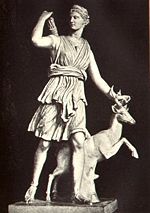
In Roman mythology, Diana was the goddess of the hunt, mythologically like to the Greek goddess Artemis. The daughter of Jupiter and Latona, Diana was born with her twin brother Apollo on the island of Delos.
A goddess of both chastity and fertility, and also of the moon, Diana's cult became popular throughout the ancient Roman empire, both among the nobility and the lower classes. She was the patron of slaves, who could find sanctuary in her temples, and of women seeking to conceive healthy children. Eternally young and beautiful, she was known to possess a quick atmosphere and fiercely dedicated her virginity.
Oft portrayed with bow and arrow and accompanied either by a deer or hounds, Diana was the goddess of both wild and domestic animals. Her temple in Ephesus was one of the wonders of the world.
Contents
- 1 Origins
- 2 Goddess of many facets
- ii.1 Diana'due south cult
- 3 Legacy
- three.1 Modern day
- 4 Run into also
- 5 References
- 6 Credits
In later centuries, Diana figured in European myths of the female person Wild Chase. During the Renaissance, she became a popular effigy in art, poetry, and drama. More than recently, her early role as a potent female deity has been examined in bookish discussions of the history of religions, and she has inspired a branch of the neo-pagan religion. She is an archetype of the competent, free-spirited, independent female person.

Diana and Apollo by Lucas Cranach
Origins
Although Diana may have once been a local woods deity in ancient Italy with a mythic origin of her ain, she inherited the legendary birth story of her Greek counterpart, Artemis. Thus, when Jupiter'southward wife Juno discovered that Latona was pregnant and that Jupiter was the father, she banned Latona from giving birth on the mainland, whatsoever island, or any state under the sun. Latona finally discovered the barren, floating island of Delos, which was neither mainland nor a real island, and gave nativity in that location to the twin gods Diana and Apollo.
Latona brought forth Diana, the elderberry twin, without struggle or pain so labored for 9 nights and nine days for Apollo. (Other versions of the story speak of one twenty-four hours and identify of Diana's birth at Ortygia.) Diana, having been born first, assisted with the birth of Apollo, accounting for her connection to childbirth and midwifery, despite her eternal status as a virginal youth.
Goddess of many facets
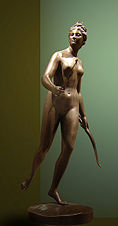
Diana huntress, by Houdon at the Louvre
Diana was the hunting goddess, associated with wildlife and woodlands. She afterwards became a moon goddess, supplanting Luna; and the moon was an emblem of chastity. Oak groves were especially sacred to her. She was praised in verse for her strength, able-bodied grace, purity, distinct beauty, and hunting skill.
Etymologically, "Diana" ways but "the Goddess," parallel to the name of Greek goddess Dione, although the two are not related mythologically. Despite her virginity, she was a goddess of fertility, worshiped especially past women seeking seeking formulation and salubrious birth. She was also the guardian of young children. Diana was regarded with great reverence by lower-course citizens and slaves, and runaway slaves could receive asylum in her temples. Diana was also a goddess of domestic animals.
Diana made up a trinity with two other Roman deities who, at the same fourth dimension, manifested aspects of her own character and attributes: Egeria the h2o nymph, who was her retainer and assistant midwife; and Virbius, the woodland god.
In paintings, bas-reliefs and statues, Diana is sometimes portrayed every bit accompanied by a deer, such as in the Diana of Versailles, equally the patroness of hunting. The deer is likewise connected to the myth of Acteon (or Actaeon), who saw Diana bathing naked and gazed at her beauty in fascination (or in some other version, attempted to rape her), whereupon Diana transformed him into a stag and fix his own hunting dogs to kill him. In another myth, Diana accidentally killed Orion afterward Apollo became alarmed at a possible romance between his sister and the giant, and tricked Diana into a target shooting test, in which the far distant target was actually the caput of Orion. Grieving at what she had washed, Diana made Orion into a constellation in the sky with his hunting dogs, Canis Major and Canis Minor close by.
Diana'south cult
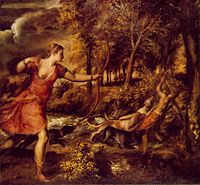
Diana defends her laurels against Acteon
Diana's cult in Italy seems to have originated in the town of Aricia near Rome, where her priest, the Rex Nemorensis ("the male monarch of the grove") remained, past the shores of Lake Nemi. At that place her uncomplicated, open-air temple was held in common by the several Latin tribes. Legend holds that a new priest could replace his predecessor by slaying him, and that men indeed battled to the expiry for this honor.
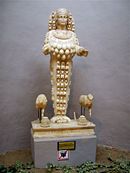
In Roman tradition, Diana was worshiped at a festival on Baronial 13, the date upon which King Servius Tullius dedicated her shrine on the Aventine Hill in Rome in the mid-sixth century B.C.E. Being placed on the Aventine, and thus outside of Rome's sacred boundaries, meant that Diana's cult essentially remained a "strange" one at this time, like that of Bacchus (Dionysus). Despite her popularity, Diana remained in this position and was never officially transferred to Rome as was the case with another deities.
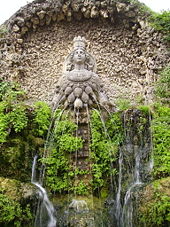
Some Roman patrons ordered marble replicas of the Anatolian version of "Diana of Ephesus," as the goddess of domestic animals. However, Diana was usually depicted by the Romans in her Greek guise, the goddess of the hunt.
Worship of Diana is also mentioned in the Bible. In Acts of the Apostles, Ephesian metalsmiths who felt threatened by Saint Paul'south preaching of Christianity, jealously rioted in Diana's defense, shouting "Great is Diana of the Ephesians!" (Acts 19:28). Her temple at Ephesus was one of the Seven Wonders of the World and was ultimately destroyed by a Christian mob led by Saint John Chrysostom in the early fifth century.
Legacy
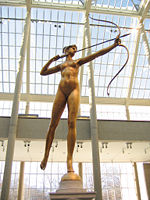
Diana, often posed every bit bathing likewise equally in her traditional guises, became a pop subject in Renaissance art. She and Apollo were sometimes pictured as a kind of pagan version of Adam and Eve. Since the Renaissance, the mythic Diana has oft been expressed in the visual and dramatic arts, including the opera L'arbore di Diana. In the sixteenth century, Diana's paradigm figured prominently at the Château de Fontainebleau, in deference to Diane de Poitiers, mistress of two French kings. At Versailles, she was incorporated into the Olympian iconography with which Louis Fourteen, the Apollo-similar "Sun Male monarch," surrounded himself.
Diana'due south worship may exist related in Early on Mod Europe to the cult of the Scottish goddess Nicevenn (aka Dame Habond, Perchta, Herodiana). She has besides been continued to myths of a female person Wild Hunt. Female members of the sect known as the Benandanti ("Good Walkers"), in their struggles against evil witches during the sixteenth and seventeenth centuries, believed that they left their bodies during the night and communed with Diana or a like goddess in defeating witchcraft.
In Italy, the religion of Stregheria embraced Diana as Queen of the (good) Witches, who were wise women and healers. According to Stregheria myths, Diana was the Mother Goddess who created the world out of her own beingness, having in herself the seeds of all creation yet to come.
Both the Romanaian word for "fairy," zânǎ and the Asturian word for "water nymph," xana, may be related to the name of Diana.
There are also references to Diana in popular literature. In Shakespeare'southward play, Romeo and Juliet, with its theme of the tension between guiltlessness and romance, contains many references to Diana. Diana is also a graphic symbol in the 1876 Leo Delibe ballet Sylvia. The plot deals with i of Diana's nymphs who is sworn to chastity, featuring Diana's assault on Sylvia'southward affections for the shepherd Amyntas.
Modern twenty-four hour period
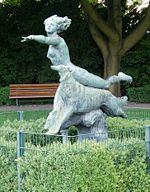
Walter Schott: Diana mit Windhunden (Diana with hunting hound)
Diana remains an important figure in contemporary thought. Feminist writers sometimes portray Diana as having originated in a mother goddess worshiped in prehistoric times when societies were organized along matriarchal lines. A co-operative of neo-paganism known as Dianic Wicca is named for her, characterized by an exclusive focus on the feminine aspect of the Divine.
In Jean Cocteau'due south 1946 film La Belle et la Bête it is Diana's power which has transformed and imprisoned the creature. In comic volume lore, the character of Wonder Adult female is a descendant of the gods, whose change ego is named Diana Prince. In a broader sense, Diana has been seen equally the archetype of the free-spirited, contained female and warrior-maiden characters that have become ubiquitous in contemporary popular literature, film, and video games.
See also
- Artemis
- Temple of Artemis
- Apollo
- Delos
References
ISBN links back up NWE through referral fees
- Downing, Christine. The Goddess: Mythological Images of the Feminine. New York: Crossroad, 1981. ISBN 9780824500917
- Gardner, Jane F. Roman Myths; Legendary by series. Austin: Academy of Texas Printing, 1993. ISBN 9780292727687
- Hicks, Peter, David Salriya, Mark Bergin, John James, Nick Hewetson, and Gerald Wood. In the Daily Life of the Ancient Romans, (Gods & Goddesses). Columbus, Ohio: Peter Bedrick Books, 2003. ISBN 9780872265950
- Lies, Betty Bonham. Earth's Daughters Stories of Women in Classical Mythology. Golden, Colo: Fulcrum Resources, 1999. ISBN 9780585288932 (Institute at Worldcat.org)
| Roman mythology series | |
|---|---|
| Major deities | Apollo · Ceres · Diana · Divus Augustus · Fortuna · Divus Julius · Juno · Jupiter · Lares · Mars · Mercury · Minerva · Neptune · Saturn · Pluto · Quirinus · Sol · Venus · Vesta · Vulcan |
Credits
New Earth Encyclopedia writers and editors rewrote and completed the Wikipedia commodity in accordance with New World Encyclopedia standards. This commodity abides past terms of the Artistic Eatables CC-by-sa 3.0 License (CC-by-sa), which may exist used and disseminated with proper attribution. Credit is due nether the terms of this license that tin reference both the New Globe Encyclopedia contributors and the selfless volunteer contributors of the Wikimedia Foundation. To cite this article click here for a list of acceptable citing formats.The history of earlier contributions past wikipedians is accessible to researchers here:
- Diana (mythology) history
The history of this article since it was imported to New World Encyclopedia:
- History of "Diana (mythology)"
Note: Some restrictions may utilize to utilise of private images which are separately licensed.
Source: https://www.newworldencyclopedia.org/entry/Diana_(mythology)
0 Response to "Neptune and Diana the Roman God and Goddess Art"
Enregistrer un commentaire