The Waves Go Out and Come in Again
Waves
Wave movement transfers energy from 1 betoken to another, usually without permanent displacement of the particles of the medium.
Learning Objectives
Describe process of energy and mass transfer during wave motion
Primal Takeaways
Key Points
- A wave tin can be thought of equally a disturbance or oscillation that travels through space-time, accompanied by a transfer of energy.
- The management a wave propagates is perpendicular to the direction it oscillates for transverse waves.
- A wave does not motion mass in the direction of propagation; information technology transfers energy.
Primal Terms
- medium: The material or empty infinite through which signals, waves or forces pass.
- direction of propagation: The axis along which the wave travels.
- wave: A moving disturbance in the energy level of a field.
Vibrations and waves are extremely important phenomena in physics. In nature, oscillations are constitute everywhere. From the jiggling of atoms to the big oscillations of ocean waves, we find examples of vibrations in almost every physical arrangement. In physics a wave can exist thought of as a disturbance or oscillation that travels through space-time, accompanied past a transfer of free energy. Wave movement transfers energy from one point to some other, often with no permanent displacement of the particles of the medium —that is, with little or no associated mass transport. They consist, instead, of oscillations or vibrations around most fixed locations.
The emphasis of the terminal point highlights an important misconception of waves. Waves transfer free energy not mass. An easy way to see this is to imagine a floating ball a few yards out to body of water. Equally the waves propagate (i.due east., travel) towards the shore, the ball volition not come towards the shore. It may come to shore eventually due to the tides, current or wind, simply the waves themselves will not carry the ball with them. A wave just moves mass perpendicular to the management of propagation—in this case up and downward, as illustrated in the figure below:
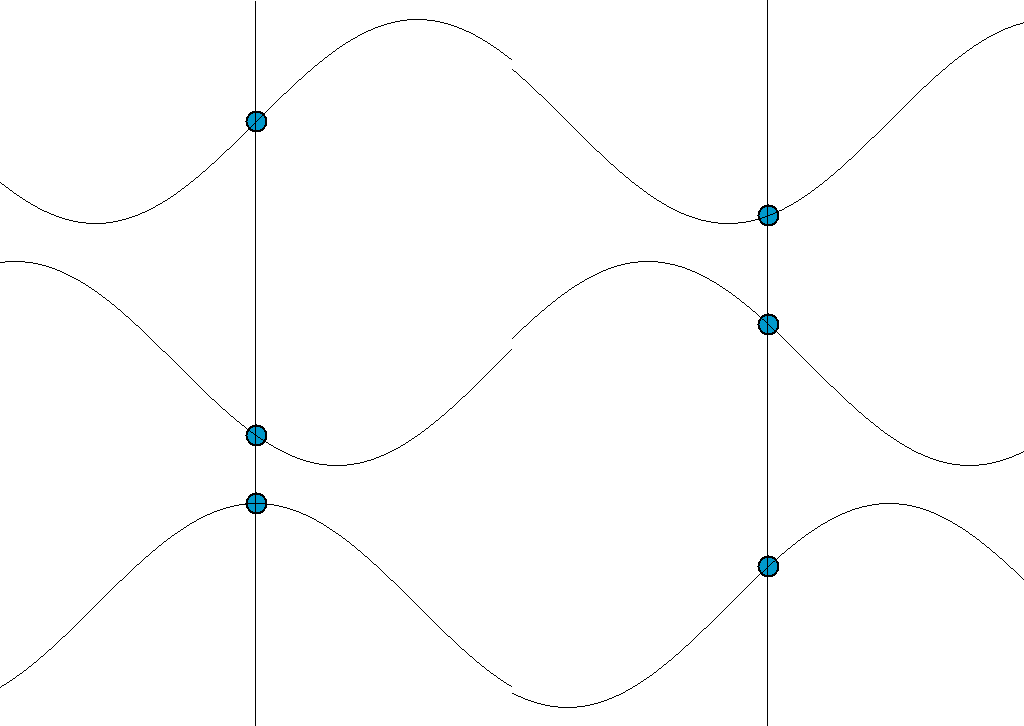
Moving ridge motion: The betoken along the axis is coordinating to the floating brawl at sea. We notice that while it moves upwards and down it does not motility in the management of the wave's propagation.
A moving ridge tin be transverse or longitudinal depending on the direction of its oscillation. Transverse waves occur when a disturbance causes oscillations perpendicular (at right angles) to the propagation (the direction of energy transfer). Longitudinal waves occur when the oscillations are parallel to the direction of propagation. While mechanical waves can exist both transverse and longitudinal, all electromagnetic waves are transverse. Sound, for example, is a longitudinal moving ridge.
The description of waves is closely related to their physical origin for each specific instance of a wave process. For case, acoustics is distinguished from optics in that sound waves are related to a mechanical rather than an electromagnetic (low-cal) wave transfer caused by vibration. Therefore, concepts such as mass, momentum, inertia or elasticity become crucial in describing acoustic (as singled-out from optic) moving ridge processes. This difference in origin introduces certain wave characteristics particular to the properties of the medium involved. In this chapter we will closely examine the departure betwixt longitudinal and transverse waves along with some of the properties they possess. We will also learn how waves are fundamental in describing move of many applicable physical systems.
Transverse Waves
Transverse waves propagate through media with a speed
orthogonally to the management of free energy transfer.
Learning Objectives
Describe properties of the transverse wave
Fundamental Takeaways
Primal Points
- Transverse waves oscillate in the z-y plane but travel along the x axis.
- A transverse wave has a speed of propagation given by the equation v = fλ.
- The direction of free energy transfer is perpendicular to the motion of the wave.
Central Terms
- wavelength: The length of a single cycle of a wave, as measured by the distance between ane peak or trough of a moving ridge and the next; it is often designated in physics as λ, and corresponds to the velocity of the moving ridge divided by its frequency.
- trough: A long, narrow depression between waves or ridges.
- speed of propagation: The speed at which a moving ridge moves through a medium.
- crest: The ridge or top of a wave.
- transverse wave: Any moving ridge in which the direction of disturbance is perpendicular to the direction of travel.
- direction of propagation: The centrality forth which the moving ridge travels.
A transverse wave is a moving wave that consists of oscillations occurring perpendicular (or right angled) to the management of free energy transfer. If a transverse wave is moving in the positive x-management, its oscillations are in up and down directions that lie in the y–z airplane. Light is an example of a transverse moving ridge. For transverse waves in matter, the displacement of the medium is perpendicular to the direction of propagation of the moving ridge. A ripple on a pond and a wave on a string are easily visualized transverse waves.
Transverse waves are waves that are aquiver perpendicularly to the direction of propagation. If you ballast 1 finish of a ribbon or string and hold the other terminate in your hand, you tin can create transverse waves past moving your hand up and downward. Notice though, that you can too launch waves past moving your hand side-to-side. This is an important betoken. There are two independent directions in which wave motion can occur. In this instance, these are the y and z directions mentioned above. depicts the movement of a transverse wave. Hither we observe that the wave is moving in t and aquiver in the 10-y plane. A wave can exist thought as comprising many particles (every bit seen in the figure) which oscillate upwardly and down. In the figure we notice this motion to exist in x-y aeroplane (denoted by the red line in the figure). Equally time passes the oscillations are separated past units of time. The issue of this separation is the sine curve we expect when nosotros plot position versus time.
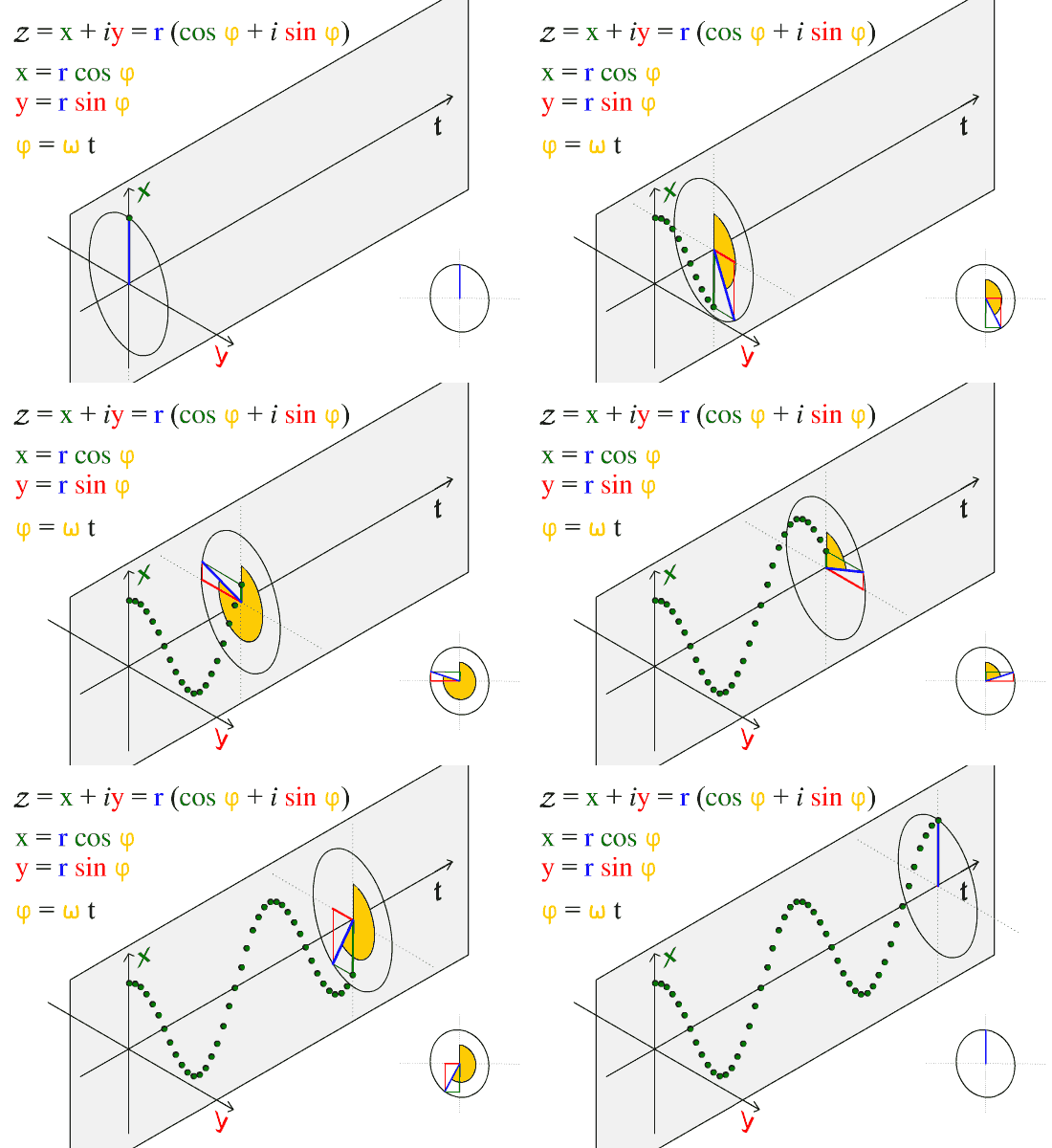
Sine Wave: The direction of propagation of this moving ridge is along the t axis.
When a wave travels through a medium--i.e., air, water, etc., or the standard reference medium (vacuum)--information technology does so at a given speed: this is called the speed of propagation. The speed at which the wave propagates is denoted and can be institute using the following formula:
where v is the speed of the moving ridge, f is the frequency , and is the wavelength. The wavelength spans crest to crest while the amplitude is 1/ii the total distance from crest to trough. Transverse waves have their applications in many areas of physics. Examples of transverse waves include seismic S (secondary) waves, and the motion of the electric (E) and magnetic (M) fields in an electromagnetic aeroplane waves, which both oscillate perpendicularly to each other also equally to the direction of energy transfer. Therefore an electromagnetic moving ridge consists of two transverse waves, visible light being an instance of an electromagnetic wave.
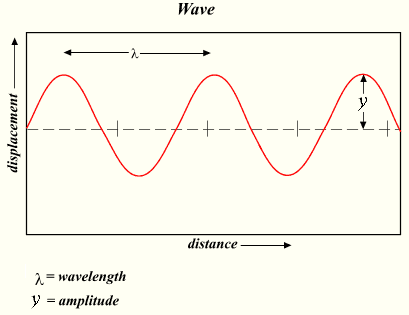
Wavelength and Amplitude: The wavelength is the altitude between adjacent crests. The amplitude is the 1/2 the distance from crest to trough.
Longitudinal Waves
Longitudinal waves, sometimes chosen compression waves, oscillate in the direction of propagation.
Learning Objectives
Give properties and provide examples of the longitudinal moving ridge
Key Takeaways
Key Points
- While longitudinal waves oscillate in the management of propagation, they do not readapt mass since the oscillations are small and involve an equilibrium position.
- The longitudinal 'waves' can be conceptualized every bit pulses that transfer energy along the centrality of propagation.
- Longitudinal waves can be conceptualized as pressure waves characterized by compression and rarefaction.
Key Terms
- rarefaction: a reduction in the density of a material, especially that of a fluid
- Longitudinal: Running in the direction of the long axis of a body.
- compression: to increase in density; the act of compressing, or the state of existence compressed; compaction
Longitudinal Waves
Longitudinal waves take the same direction of vibration as their direction of travel. This means that the movement of the medium is in the aforementioned direction equally the motion of the wave. Some longitudinal waves are also called compressional waves or compression waves. An like shooting fish in a barrel experiment for observing longitudinal waves involves taking a Slinky and belongings both ends. Later compressing and releasing 1 end of the Slinky (while still holding onto the finish), a pulse of more concentrated coils volition travel to the terminate of the Slinky.
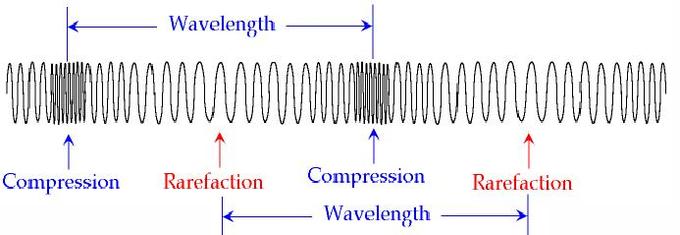
Longitudinal Waves: A compressed Slinky is an example of a longitudinal wave. The moving ridge propagates in the aforementioned management of oscillation.
Like transverse waves, longitudinal waves do not readapt mass. The difference is that each particle which makes up the medium through which a longitudinal moving ridge propagates oscillates along the axis of propagation. In the example of the Slinky, each coil will oscillate at a point only volition not travel the length of the Slinky. It is of import to recollect that free energy, in this case in the form of a pulse, is being transmitted and not the displaced mass.
Longitudinal waves tin sometimes also exist conceptualized as pressure waves. The near common pressure level wave is the sound moving ridge. Sound waves are created by the compression of a medium, unremarkably air. Longitudinal sound waves are waves of alternating pressure level deviations from the equilibrium pressure, causing local regions of compression and rarefaction. Thing in the medium is periodically displaced by a sound wave, and thus oscillates. When people make a sound, whether information technology is through speaking or hitting something, they are compressing the air particles to some meaning amount. By doing so, they create transverse waves. When people hear sounds, their ears are sensitive to the pressure differences and interpret the waves equally dissimilar tones.
Water Waves
Water waves tin be commonly observed in daily life, and contain both transverse and longitudinal wave movement.
Learning Objectives
Describe particle move in water waves
Key Takeaways
Key Points
- The particles which make upwards a water wave motion in circular paths.
- If the waves move slower than the wind above them, free energy is transfered from the current of air to the waves.
- The oscillations are greatest on the surface of the wave and get weaker deeper in the fluid.
Key Terms
- phase velocity: The velocity of propagation of a pure sine wave of infinite extent and infinitesimal amplitude.
- group velocity: The propagation velocity of the envelope of a modulated travelling wave, which is considered as the propagation velocity of data or energy independent in information technology.
- plane wave: A constant-frequency moving ridge whose wavefronts (surfaces of constant stage) are infinite parallel planes of constant acme-to-peak amplitude normal to the phase velocity vector.
Water waves, which can be commonly observed in our daily lives, are of specific interest to physicists. Describing detailed fluid dynamics in h2o waves is beyond the telescopic of introductory physics courses. Although nosotros oft observe h2o wave propagating in second, in this atom nosotros will limit our discussion to 1D propagation.
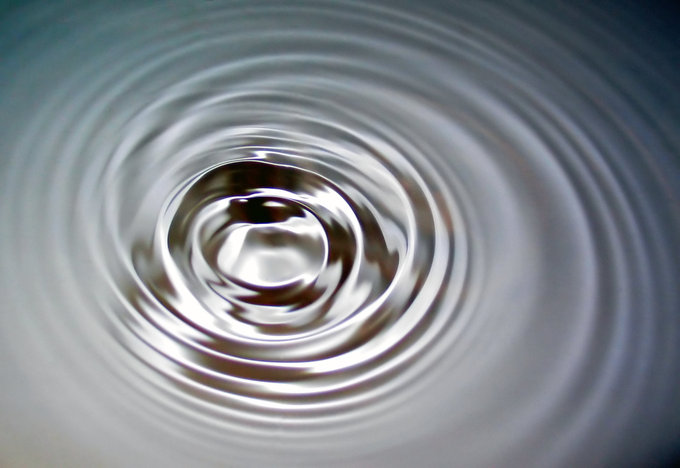
H2o waves: Surface waves in water
The uniqueness of water waves is establish in the observation that they incorporate both transverse and longitudinal wave motion. As a result, the particles composing the wave move in clockwise round motion, as seen in. Oscillatory motion is highest at the surface and diminishes exponentially with depth. Waves are generated by wind passing over the surface of the sea. As long as the waves propagate slower than the air current speed just in a higher place the waves, there is an energy transfer from the wind to the waves. Both air force per unit area differences betwixt the upwind and the lee side of a wave crest, likewise as friction on the h2o surface past the wind (making the water to go into the shear stress), contribute to the growth of the waves.
In the case of monochromatic linear airplane waves in deep water, particles near the surface move in circular paths, creating a combination of longitudinal (back and forth) and transverse (up and down) wave motions. When waves propagate in shallow water (where the depth is less than half the wavelength ), the particle trajectories are compressed into ellipses. As the wave amplitude (meridian) increases, the particle paths no longer form closed orbits; rather, after the passage of each crest, particles are displaced slightly from their previous positions, a phenomenon known as Stokes drift.
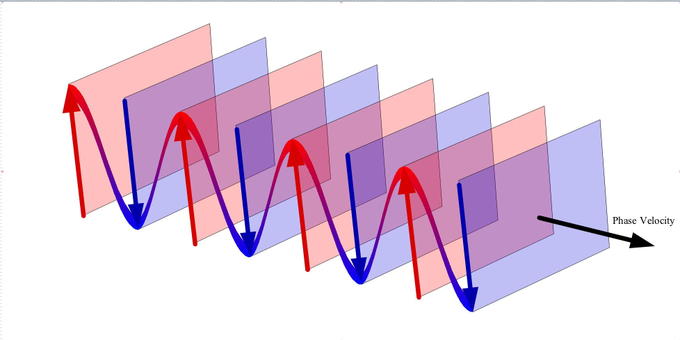
Plane wave: Nosotros come across a wave propagating in the direction of the phase velocity. The wave tin can be thought to be made up of planes orthogonal to the direction of the phase velocity.
Since h2o waves ship energy, attempts to generate power from them have been made by utilizing the physical move of such waves. Although larger waves are more powerful, wave power is likewise adamant by wave speed, wavelength, and water density. Deep water corresponds with a water depth larger than half the wavelength, every bit is a mutual example in the sea and ocean. In deep water, longer-menstruum waves propagate faster and transport their energy faster. The deep-water group velocity is one-half the phase velocity. In shallow water for wavelengths larger than nearly xx times the h2o depth (as often found most the declension), the group velocity is equal to the phase velocity. These methods take proven viable in some cases simply do non provide a fully sustainable class of renewable energy to date.
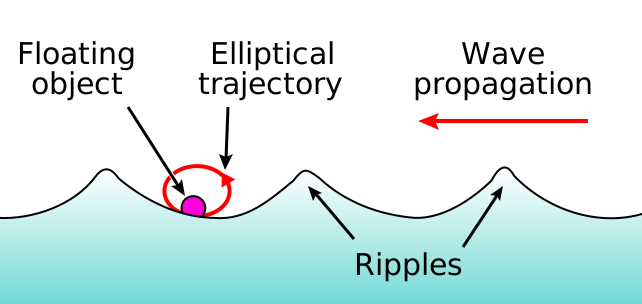
Water waves: The motion water waves causes particles to follow clockwise circular motion. This is a result of the wave having both transverse and longitudinal properties.
Wavelength, Freqency in Relation to Speed
Waves are defined past its frequency, wavelength, and amplitude among others. They likewise have two kinds of velocity: phase and grouping velocity.
Learning Objectives
Identify major characteristic backdrop of waves
Key Takeaways
Key Points
- The wavelength is the spatial menstruation of the wave.
- The frequency of a moving ridge refers to the number of cycles per unit fourth dimension and is not to be confused with angular frequency.
- The phase velocity can exist expressed as the product of wavelength and frequency.
Key Terms
- moving ridge speed: The absolute value of the velocity at which the stage of any 1 frequency component of the wave travels.
- wavelength: The length of a single cycle of a wave, as measured past the distance betwixt ane peak or trough of a wave and the adjacent; it is often designated in physics equally λ, and corresponds to the velocity of the wave divided past its frequency.
- frequency: The caliber of the number of times n a periodic phenomenon occurs over the fourth dimension t in which it occurs: f = n / t.
Characteristics of Waves
Waves have certain characteristic backdrop which are appreciable at commencement find. The first belongings to note is the aamplitude. The amplitude is one-half of the distance measured from crest to trough. Nosotros too detect the wavelength, which is the spatial period of the moving ridge (e.g. from crest to crest or trough to trough). Nosotros denote the wavelength by the Greek letter
.
The frequency of a wave is the number of cycles per unit time -- ane can think of information technology as the number of crests which pass a fixed bespeak per unit time. Mathematically, we make the observation that,
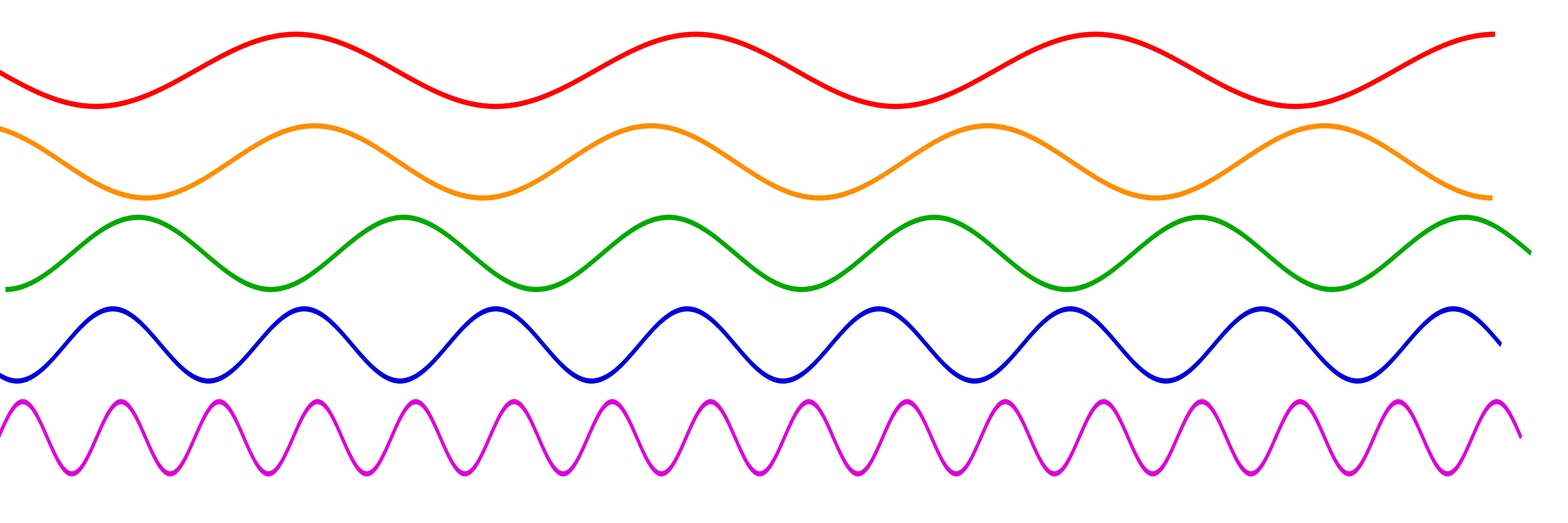
Frequencies of different sine waves.: The carmine wave has a depression frequency sine there is very little repetition of cycles. Conversely nosotros say that the purple wave has a high frequency. Note that time increases along the horizontal.
where T is the period of oscillation. Frequency and wavelength can likewise be related-* with respects to a "speed" of a wave. In fact,
where v is called the wave speed, or more commonly,the stage velocity, the rate at which the phase of the wave propagates in infinite. This is the velocity at which the phase of any one frequency component of the moving ridge travels. For such a component, any given stage of the wave (for example, the crest) will appear to travel at the phase velocity.
Finally, the group velocity of a wave is the velocity with which the overall shape of the waves' amplitudes — known as the modulation or envelope of the wave — propagates through space. In, one may see that the overall shape (or "envelope") propagates to the correct, while the phase velocity is negative.
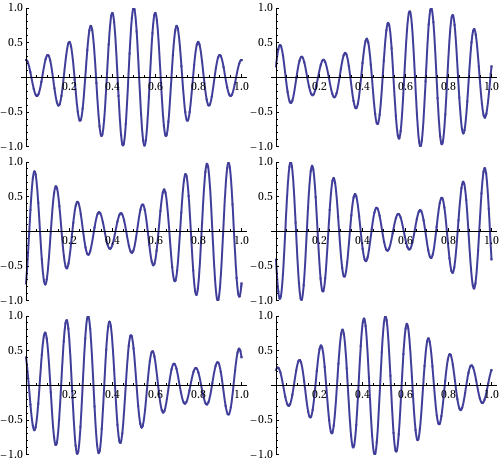
Fig 2: This shows a wave with the group velocity and phase velocity going in different directions. (The group velocity is positive and the phase velocity is negative. )
Energy Transportation
Waves transfer free energy which can exist used to do work.
Learning Objectives
Chronicle direction of energy and moving ridge transportation
Key Takeaways
Key Points
- Waves which are more than massive transfer more free energy.
- Waves with greater velocities transfer more energy.
- Free energy of a wave is transported in the management of the waves transportation.
Key Terms
- free energy: A quantity that denotes the ability to do work and is measured in a unit dimensioned in mass × distance²/time² (ML²/T²) or the equivalent.
- power: A measure of the rate of doing work or transferring free energy.
- work: A measure of energy expended in moving an object; most commonly, force times displacement. No piece of work is done if the object does not motion.
Energy transportion is essential to waves. It is a mutual misconception that waves move mass. Waves conduct energy forth an axis defined to be the direction of propagation. Ane easy case is to imagine that y'all are standing in the surf and you are hit by a significantly big wave, and once you are hitting you are displaced (unless you concur firmly to your ground!). In this sense the wave has washed piece of work (it applied a strength over a distance). Since piece of work is done over time, the energy carried past a wave tin can be used to generate power.
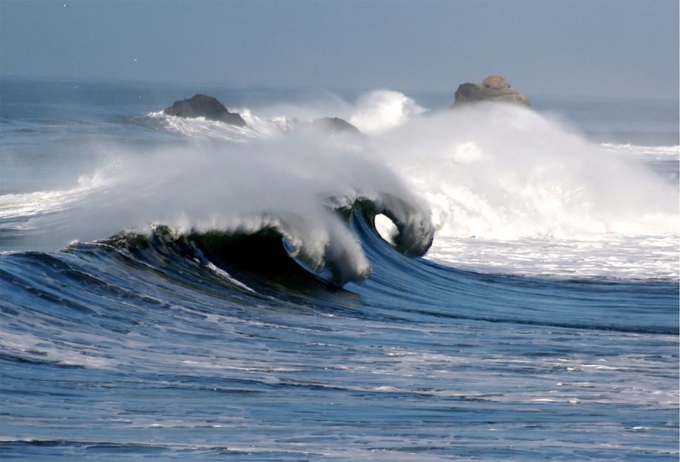
Water Wave: Waves that are more than massive or take a greater velocity send more than energy.
Similarly we find that electromagnetic waves carry free energy. Electromagnetic radiations (EMR) carries energy—sometimes called radiant energy—through infinite continuously abroad from the source (this is not true of the near-field part of the EM field). Electromagnetic waves can be imagined every bit a cocky-propagating transverse oscillating moving ridge of electrical and magnetic fields. EMR also carries both momentum and athwart momentum. These properties may all exist imparted to matter with which information technology interacts (through work). EMR is produced from other types of energy when created, and it is converted to other types of energy when it is destroyed. The photon is the quantum of the electromagnetic interaction, and is the basic "unit" or elective of all forms of EMR. The quantum nature of lite becomes more apparent at loftier frequencies (or high photon free energy). Such photons behave more similar particles than lower-frequency photons practice.
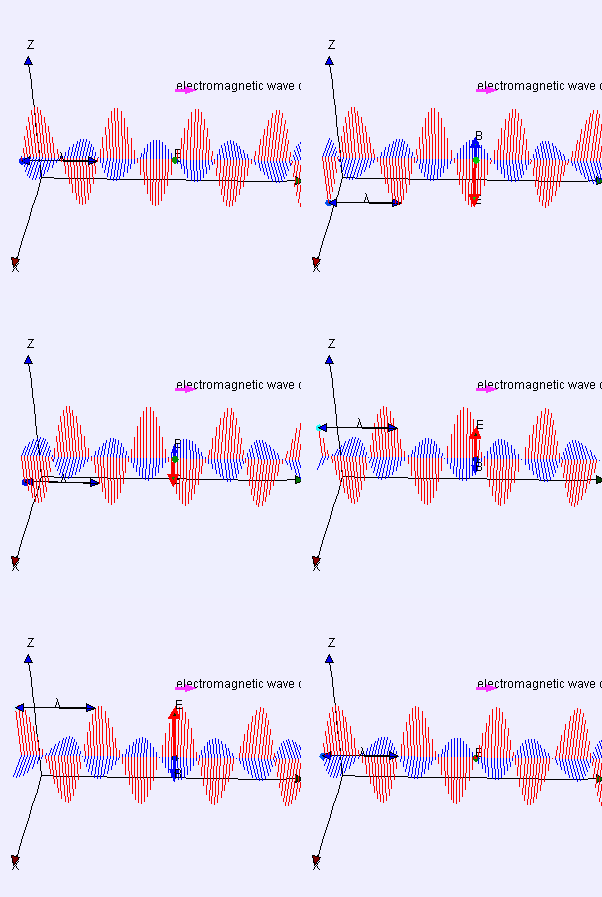
Electromagnetic Wave: Electromagnetic waves can be imagined as a self-propagating transverse aquiver wave of electric and magnetic fields. This 3D diagram shows a plane linearly polarized wave propagating from left to correct.
In general, there is a relation of waves which states that the velocity (
) of a wave is proportional to the frequency (
) times the wavelength (
):
We also know that classical momentum
is given by
which relates to force via Newton'southward second law:
EM waves with higher frequencies acquit more than energy. This is a direct effect of the equations above. Since
we find that higher frequencies imply greater velocity. If velocity is increased then nosotros have greater momentum which implies a greater strength (information technology gets a little flake tricky when we talk about particles moving close to the speed of light, but this observation holds in the classical sense). Since free energy is the ability of an object to do piece of work, we find that for
a greater force correlates to more energy transfer. Again, this is an like shooting fish in a barrel miracle to experience empirically; only stand in front of a faster wave and experience the deviation!
Licenses and Attributions
Source: https://courses.lumenlearning.com/boundless-physics/chapter/waves/
0 Response to "The Waves Go Out and Come in Again"
Enregistrer un commentaire